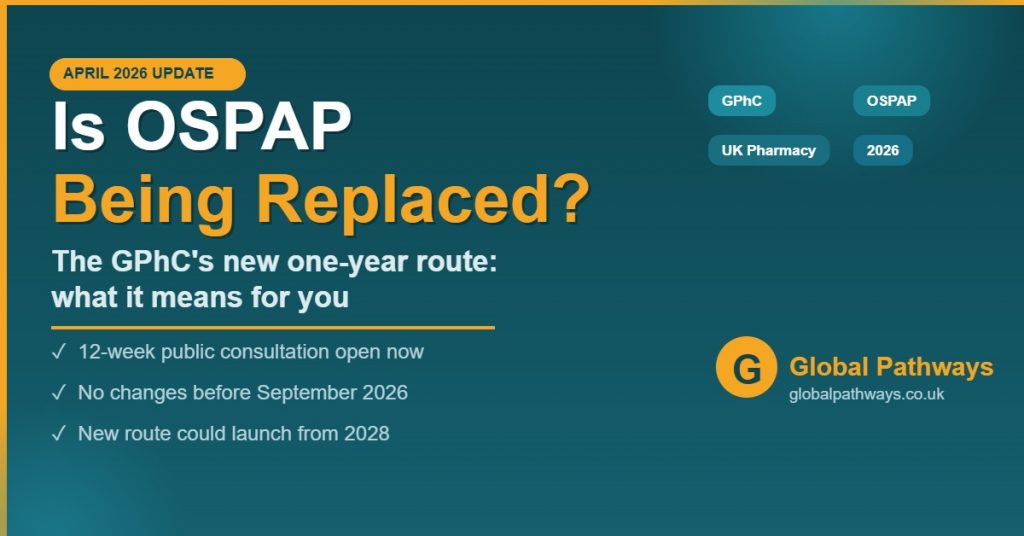
Short answer: Yes — but not yet, and not before 2028 at the earliest.
If you are an internationally qualified pharmacist planning to register in Great Britain through the Overseas Pharmacists’ Assessment Programme (OSPAP), you have probably come across alarming headlines about the programme being scrapped. The General Pharmaceutical Council (GPhC) did indeed propose a significant overhaul of the OSPAP route at its council meeting on 26 March 2026 — and a 12-week public consultation on those proposals is now open.
This article breaks down exactly what is being proposed, why the GPhC wants to change the current system, what the new route would look like, and — most importantly — what it means for anyone planning to apply for OSPAP in 2026 or 2027.
What Did the GPhC Announce in March 2026?
At its council meeting on 26 March 2026, the GPhC presented papers proposing to replace the current two-year route to registration for internationally qualified pharmacists with a single, integrated one-year programme. If the council approved those papers — which it did — the proposals would be opened for a 12-week public consultation starting in April 2026.
The current two-year route works like this: an internationally qualified pharmacist first completes a one-year OSPAP postgraduate diploma at an accredited UK university, then completes a one-year foundation training year before sitting the GPhC registration assessment. Only after passing that assessment can they join the pharmacist register in Great Britain.
The proposed replacement collapses both of those years into a single, one-year programme that integrates academic study and in-practice learning simultaneously — more closely mirroring the route taken by pharmacists who trained in the UK from 2025 onwards.
The GPhC’s official update on revising the route to registration for internationally qualified pharmacists states the proposals could be in place from 2028, and that there will be no changes to the OSPAP course until September 2026 at the earliest.
Why Is OSPAP Being Changed?
The pressure to reform OSPAP has been building for several years. Three key drivers explain why the GPhC has reached this point.
1. Cost and Time Burdens on International Pharmacists
The current two-year pathway is expensive and time-consuming. OSPAP tuition fees alone can run between £9,000 and £15,000 depending on the university, and that is before living costs, travel, and the additional year of foundation training. Many internationally qualified pharmacists — particularly those from lower-income countries — find the financial barrier prohibitive. Reducing the route to a single year would directly cut both cost and time to registration.
2. The Scrapped Three-Tier System
The current proposals did not emerge out of nowhere. The GPhC had previously floated an alternative three-tier system that would have created different registration pathways depending on the country where a pharmacist qualified. Under that model, pharmacists from countries like Australia, New Zealand, and Ireland could have registered within three to four months, while pharmacists from countries like India, Pakistan, and Nigeria would still face a one-year programme.
The three-tier proposal faced heavy criticism. The UK Black Pharmacists Association (UKBPA) described it as “troublesome” and raised concerns that it held “the potential for indirect discrimination against aspiring members of the UK pharmacy workforce who have received their education in Africa.” Given that approximately 65% of all OSPAP applications between 2021 and 2026 came from India, Pakistan, and Nigeria, the fairness concerns were significant.
The GPhC listened. The three-tier proposal was dropped in favour of the current single-route model, which applies to all internationally qualified pharmacists equally, regardless of their country of origin.
3. Aligning with the New UK Pharmacy Standards
A further driver is the GPhC’s 2021 education and training standards for UK pharmacists, which came into effect for graduates from 2025. Under those new standards, UK-trained pharmacists qualify as independent prescribers upon registration — a major expansion of the pharmacist’s role. The GPhC wants the new route for internationally qualified pharmacists to include independent prescribing training too, ensuring parity between domestic and internationally trained pharmacists entering the UK workforce.
What Would the New One-Year Route Look Like?
The proposed programme is designed as an integrated year — meaning academic study and learning in practice happen together, not sequentially as under the current OSPAP-then-foundation model.
Key features of the proposed new route include:
- A single year of combined academic learning and in-practice training, focused specifically on pharmacy practice in Great Britain
- Mandatory independent prescribing training — the same minimum number of prescribing hours required for existing standalone post-registration independent prescribing qualifications
- A GPhC registration assessment at the end — overseas pharmacists will still need to pass the registration assessment before they can join the pharmacist register
- A single pathway for all internationally qualified pharmacists — no tiering by country of origin
In short, the new route is shorter and more clinically oriented than the current OSPAP, and it would produce internationally trained pharmacists who register as independent prescribers — something the current OSPAP route does not guarantee.
The Exact Timeline: When Will Changes Happen?
Understanding the timeline is critical for anyone making decisions about their OSPAP application right now. Here is how things stand as of April 2026:
- 26 March 2026 — GPhC council meeting. Proposals for the new one-year route were presented and approved for public consultation.
- April 2026 (ongoing) — 12-week public consultation opens. Stakeholders, universities, professional bodies, and internationally qualified pharmacists can respond.
- Mid-2026 — GPhC reviews consultation responses and finalises proposals.
- September 2026 (at the earliest) — No changes to OSPAP before this date. All 2026 OSPAP intakes run as normal.
- 2027–2028 — New standards developed, universities accredited for the new programme.
- 2028 (earliest) — New one-year integrated route could come into effect.
The GPhC has confirmed it is contacting internationally qualified pharmacists who are planning to apply for OSPAP courses to reassure them that no changes will happen before September 2026 at the earliest.
What Does This Mean for Current OSPAP Students?
If you are currently enrolled in an OSPAP course, or if you are in your foundation year having already completed OSPAP, this proposal does not affect you. You will complete your programme under the existing rules and sit the GPhC registration assessment as planned. There are no retrospective changes being proposed, and your OSPAP qualification is not under threat.
Pharmacists who complete OSPAP and their foundation year under the current system before the new route is introduced will register with GPhC as pharmacists in the normal way. The only difference is they may need to pursue independent prescribing as a separate qualification if they want that status — since OSPAP graduates under the current system do not automatically qualify as independent prescribers.
Should You Still Apply for OSPAP in 2026 or 2027?
Yes — and here is why.
The earliest any change could come into force is 2028. That means the September 2026 OSPAP intake and the September 2027 intake will run under the current programme structure. If you start OSPAP in September 2026, you will complete your postgraduate diploma by June 2027 and begin your foundation year thereafter — finishing and registering well before the new route is scheduled to begin.
Waiting for the new programme carries its own risks. The 2028 date is the earliest possible implementation — it depends on the consultation going smoothly, universities being accredited in time, and no delays in regulatory approvals. The history of pharmacy regulation reform in the UK suggests these timelines frequently slip. Pharmacists who apply and start OSPAP now could be registered by late 2028, potentially earlier than those who wait for the new route to be available.
There is also the question of competition. Once the new one-year route is announced and confirmed, demand for places is likely to rise sharply. Early movers who complete OSPAP under the current system will be ahead of that queue.
Our strong advice: if you meet the eligibility criteria and want to register as a pharmacist in Great Britain, do not let the reform proposals delay your application. Apply for the 2026 or 2027 OSPAP intake and start your journey now.
How Many Pharmacists Does This Affect?
According to GPhC data, approximately 400 students undertake the OSPAP each year. Around half — approximately 200 per year — qualified in India, Pakistan, Nigeria, or Egypt. In total, 65% of OSPAP applications between 2021 and 2026 came from pharmacists who trained in India, Pakistan, or Nigeria.
These numbers make clear why the GPhC’s reform is significant — and why the fairness of the new system matters so much to those communities. The UKBPA’s welcome of the single-route proposal, after years of campaigning against discriminatory tiering, reflects the importance of getting this right.
Frequently Asked Questions About OSPAP Being Replaced
Is OSPAP being replaced?
Yes, but the replacement has not happened yet. The GPhC is currently consulting (April 2026) on proposals to replace OSPAP with a new integrated one-year route. The earliest any change could take effect is 2028.
When will OSPAP be replaced?
If the April 2026 consultation proceeds and the proposals are finalised, the new route could be introduced from 2028. The GPhC has confirmed no changes will happen before September 2026 at the very earliest.
What is replacing OSPAP?
The proposed replacement is a single one-year integrated programme that combines academic study at a UK university with learning in practice. It will include independent prescribing training and still require passing the GPhC registration assessment.
Will the new route be faster than OSPAP?
Yes. The current route is two years (OSPAP + foundation year). The proposed new route is one integrated year, halving the time to registration.
Will the new route be cheaper?
Costs for the new programme have not yet been set. However, reducing from two years to one year will significantly reduce overall costs — tuition fees, living expenses, and lost earnings during training.
Does the new route include independent prescribing?
Yes. The GPhC has specifically proposed that the new one-year programme will include the same minimum number of independent prescribing hours as required for existing standalone post-registration independent prescribing qualifications. Pharmacists completing the new route would register as independent prescribers — something OSPAP graduates under the current system do not automatically gain.
Can I still apply for OSPAP from India, Pakistan or Nigeria?
Absolutely. OSPAP is still running and taking applications for the September 2026 intake. Pharmacists from India, Pakistan, Nigeria, Egypt, and all other non-EEA countries can apply now. The proposed changes do not affect eligibility.
I am currently doing OSPAP — does this affect me?
No. If you are currently enrolled in OSPAP, you will complete your programme and registration assessment under the current rules. There are no retrospective changes and your OSPAP qualification will be fully valid.
What happened to the three-tier system the GPhC proposed before?
The three-tier system — which would have created different registration routes depending on a pharmacist’s country of qualification — was scrapped after significant criticism about fairness and potential indirect discrimination. The GPhC replaced it with the current single-route proposal, which applies to all internationally qualified pharmacists equally.
Is OSPAP still worth doing given the upcoming changes?
Yes. OSPAP remains the only available route right now. The new programme is at least two years away. Starting OSPAP in 2026 or 2027 means you could be registered before the new route even exists.
The Bottom Line
OSPAP is being replaced — eventually. The GPhC’s consultation, which opened in April 2026, marks a genuine turning point in the history of UK pharmacy registration for internationally qualified pharmacists. The proposed new one-year integrated route is designed to be fairer, faster, and better aligned with the direction of UK pharmacy practice.
But “eventually” is not now. No changes will happen before September 2026 at the earliest, and the new programme is unlikely to launch before 2028. For internationally qualified pharmacists from India, Pakistan, Nigeria, Egypt, the Philippines, and beyond, the pathway through OSPAP is still open, still valid, and still the right move.
Do not let uncertainty about future policy delay a decision you can make today.
Need Help Navigating OSPAP?
At Global Pathways, we specialise in guiding international pharmacists through every stage of the OSPAP process — from eligibility confirmation and university applications to OET preparation, student visas, and foundation year placements. We work with pharmacists from Pakistan, India, Nigeria, Egypt, the Philippines, and over ten other countries.
Book a free OSPAP consultation today — no obligation, just expert guidance.
References and Further Reading
- GPhC — Revising the route to registration for internationally-qualified pharmacists: update
- GPhC Council Meeting, 26 March 2026
- The Pharmaceutical Journal — One-year route to registration for overseas qualified pharmacists proposed by regulator
- The Pharmaceutical Journal — New training standards for overseas pharmacists to include prescribing
- The Pharmacist — UKBPA welcomes single route to register internationally qualified pharmacists
- GPhC — Non-EEA qualified international pharmacists (official guidance)